


“Follow the trend.”
It is probably the most commonly cited concept in trading.
Most traders wait patiently for markets to break out before entering a position. When prices move sideways, they often stay on the sidelines, waiting for a clear direction.
But some traders see opportunity exactly where others see uncertainty.
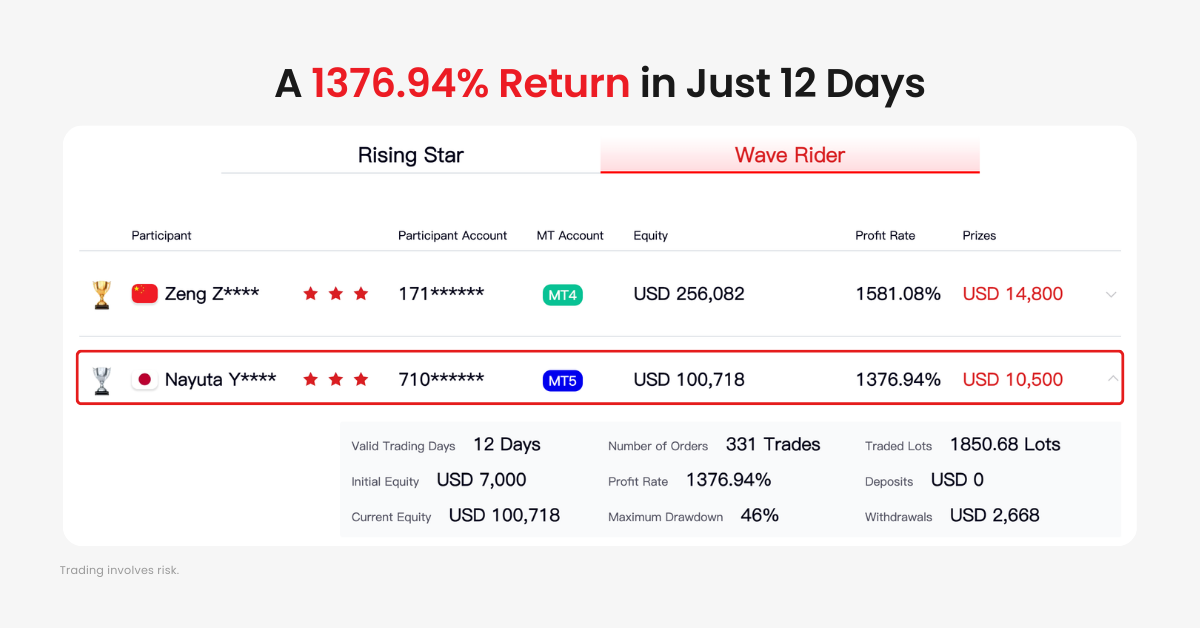
Nayuta Yokoyama, a trader from Japan competing in the #DooTrader Charity Trading Cup, delivered a remarkable 1376.94% return in just 12 days, finishing second in his group.
While many traders wait for one large market move, Yokoyama approaches the market differently.
Where some traders strike like heavy hammers, waiting for the perfect breakout, Yokoyama trades more like a Japanese ninja. Fast, flexible, and precise.
Instead of chasing trends, he builds profits through high-frequency grid trading, capturing small opportunities again and again.
To understand the thinking behind this approach, D Prime invited Nayuta Yokoyama for an exclusive interview.
#DooTrader Trader Profile
Name: Nayuta Yokoyama
Nationality: Japan
Return: 1376.94%
Ranking: 2nd (Breakout Group)
Experience: 18 years in the forex market, full-time trader
Trading Motto
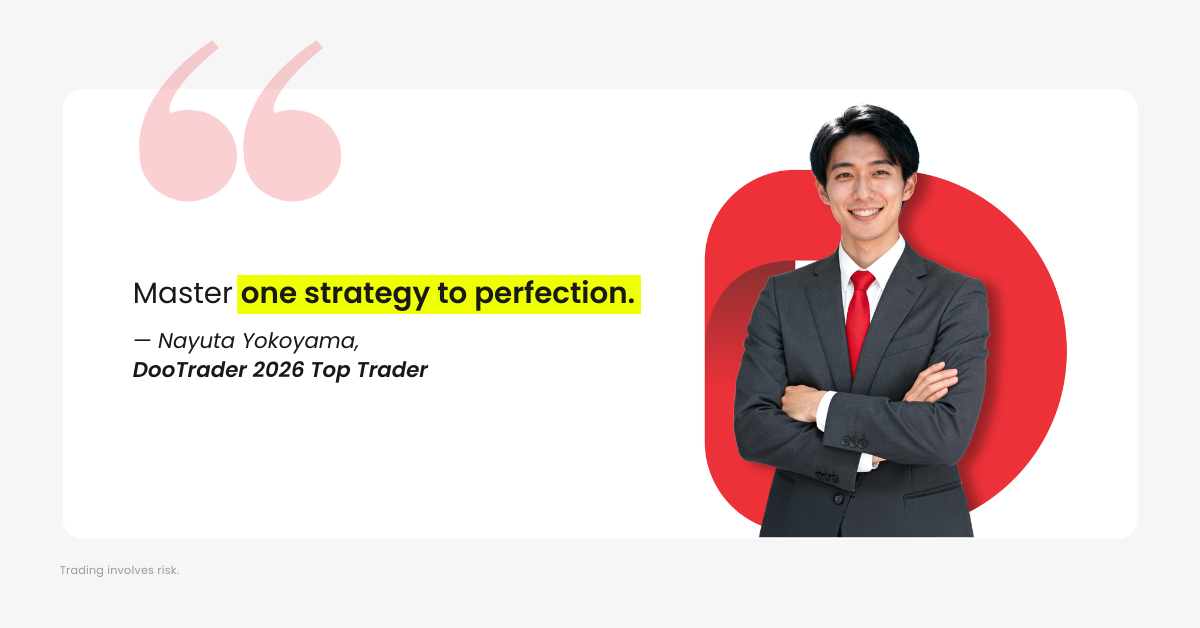
Master one strategy to perfection.
Exclusive Interview: Precision in Sideways Markets
A System Designed for Short-Term Returns
D Prime: Congratulations on your impressive performance. A 1376.94% return is extraordinary. How did you feel when you saw the results?
Yokoyama: Thank you. I was very happy, of course.
D Prime: Were you surprised by the outcome?
Yokoyama: Not really. My trading system is designed specifically to generate strong short-term returns.
For Yokoyama, the outcome was not unexpected. It was simply the result of executing a strategy he has spent years refining.
The Logic Behind His Grid Trading Strategy
D Prime: Could you explain how your strategy works?
Yokoyama: I use a grid trading strategy.
For example, if the price rises, I open a small short position, usually 0.01 lots. If the price continues rising, I gradually add more positions.
If the market moves down, I do the same with buy orders to lower the average entry price.
Once I see a small profit across the combined positions, I close everything.
Each trade only produces a small gain, but those gains accumulate quickly.
Managing the Risks of Grid Trading
Grid trading is often considered dangerous. If the market trends strongly in one direction, positions can accumulate quickly and create large drawdowns.
D Prime: Many traders believe grid trading is extremely risky. If the price never reverses, the account could be wiped out. How do you deal with that risk?
Yokoyama: That usually happens when traders do not fully understand grid trading.
Many people add positions too close together or increase their lot sizes too aggressively.
I avoid that.
Yokoyama limits his trading to AUDNZD and EURGBP, two currency pairs known for their relatively stable and sideways behavior.
He also uses ATR (Average True Range) to determine the spacing between positions instead of fixed price intervals.
This adjustment helps the grid adapt to changing market volatility.
Mastering One Strategy
Many traders constantly search for new strategies.
Yokoyama chose a different path.
D Prime: So, your system is more complex than a standard grid?
Yokoyama: Yes. I spent many years refining it.
D Prime: Do you use other strategies, such as trend following or swing trading?
Yokoyama: No. I only trade grid strategies.
I believe if you truly master one single strategy, that is enough to build a career in trading.
For him, the goal is not variety.
It is precision.
Insights for New Traders
D Prime: Many beginners are attracted to strategies that promise high returns. What tips would you give them?
Yokoyama: Be very careful.
Grid trading may look simple, but the risk can be significant.
Practice extensively before using it with real capital.
He also warns against constantly switching strategies.
Many traders jump from one trading robot to another whenever a system stops working.
Yokoyama describes this behavior bluntly.
“Do not trade like a headless chicken.”
Instead, traders should develop their own system and refine it over time.
Consistency matters more than constant experimentation.
The Craftsman of Sideways Markets
If Randhawa Aruna represents disciplined risk control, Wei Tengfei represents explosive conviction, and Yu Zaishek represents the power of timing, then Nayuta Yokoyama represents mastery of structure.
While many traders search for strong trends, Yokoyama specializes in the market conditions others often avoid.
Sideways markets frustrate most traders.
For Yokoyama, they are an opportunity.
Instead of waiting for one large move, he captures small profits repeatedly through a carefully refined grid strategy.
His results remind us that success in trading does not come from chasing every opportunity.
It comes from understanding one approach deeply and executing it with discipline.
In a market full of noise, Yokoyama shows that sometimes the greatest edge is not speed or aggression, but precision repeated thousands of times.
Across this season of the #DooTrader Charity Trading Cup, each standout trader reveals a different path to success. Discipline, conviction, timing, and precision. Different styles, but the same goal.
And as the competition moves closer to its final stage, one question remains.
Which style will ultimately prevail?
Risk Disclosure
Trading in Securities, Futures, contracts for difference (CFDs) and other financial products carries high risks due to the rapid and unpredictable fluctuation in the value and prices of these financial instruments. This unpredictability is due to the adverse and unpredictable market movements, geopolitical events, economic data releases, and other unforeseen circumstances. You may sustain substantial losses including losses exceeding your initial investment within a short period of time.
You are strongly advised to fully understand the nature and inherent risks of trading with the respective financial instrument before engaging in any transactions with us. When you engage in transactions with D Prime, you acknowledge that you are aware of and accept these risks.
Disclaimer
The views, opinions, and statements expressed by traders or guests are solely those of the individual and do not reflect or represent the views or positions of D Prime. D Prime does not endorse, guarantee, or take responsibility for any statements, trading strategies, or opinions expressed by such individuals.
This information contained in this article is for general informational and educational purposes only and should not be considered as financial, investment, legal, tax or any other form of professional advice, recommendation, an offer, or an invitation to buy or sell any financial instruments. The content herein, including but not limited to data, analyses and market commentary, is presented based on internal records and/or publicly available information and may be subject to change or revision at any time without notice and it does not consider any specific recipient’s investment objectives or financial situation. Past performance references are not reliable indicators of future performance.
D Prime and its affiliates make no representations or warranties about the accuracy or completeness or reliability of this information and disclaim any and all liability for any direct, indirect, incidental, consequential, or other losses or damages arising out of or in connection with the use of or reliance on any information contained in this article. The above information should not be used or considered as the basis for any trading decisions or as an invitation to engage in any transaction. Do not rely on this article to replace your independent judgment. You should conduct your own research and consult with an independent qualified financial advisor or professional before making any financial trading or investment decisions.
“D Prime” is a brand name of D Prime Vanuatu Limited, a company incorporated and regulated by the Vanuatu Financial Services Commission (Company Number: 700238). The availability of products and services may vary depending on jurisdiction and applicable regulatory requirements.